 中文
 English
 Espa?ol
 Русский
Current position:Home > News & Events > Events
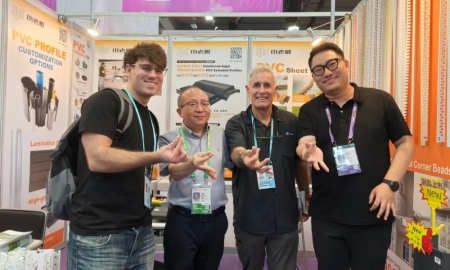
Carbon Fibre Reinforced PVC Sheet Pile Debuts at Canton Fair Phase 2
140TH CANTON FAIR · PHASE 2 · 23—27 OCT 2026 · BOOTH 12.2H40, GUANGZHOU
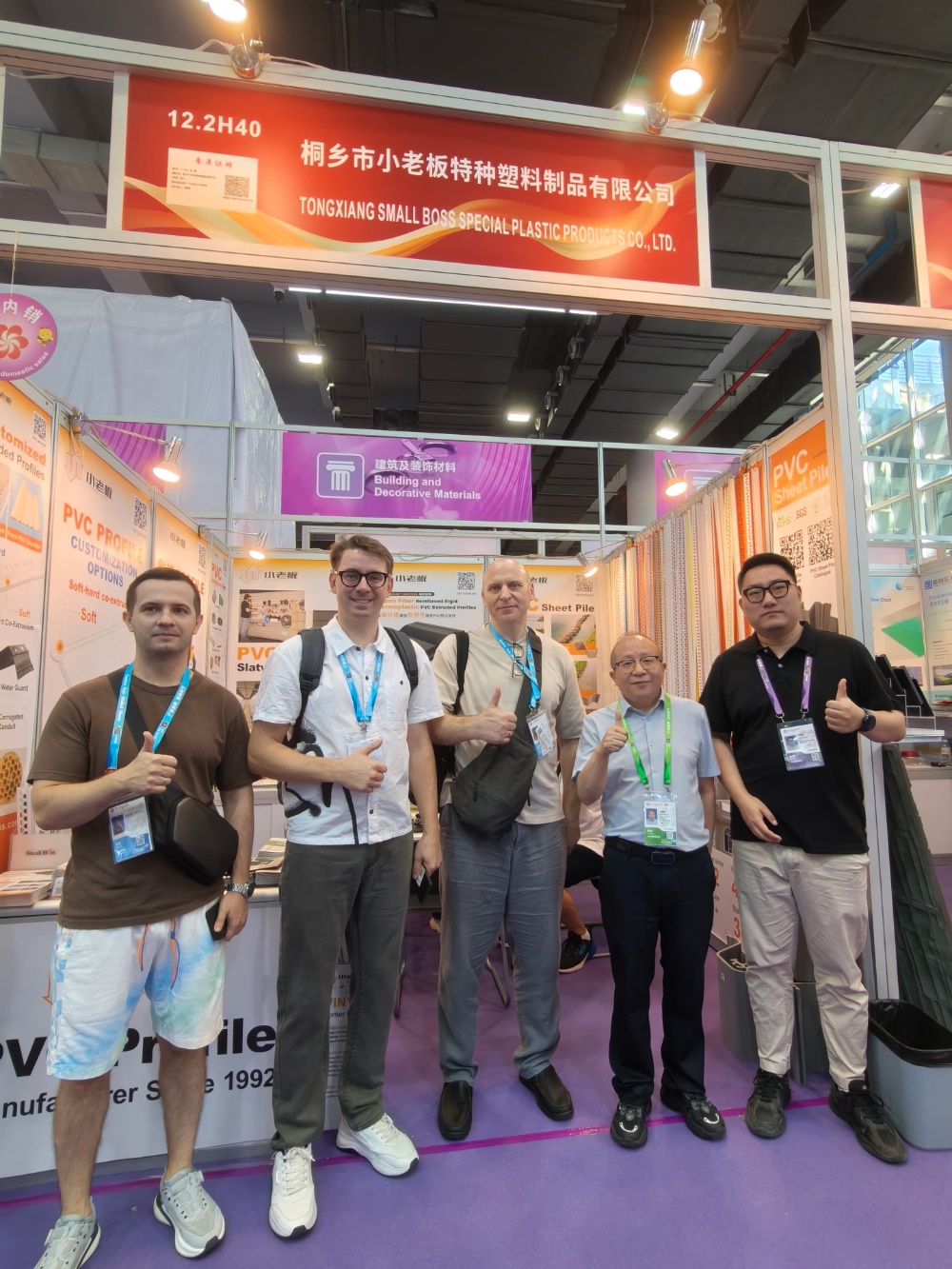
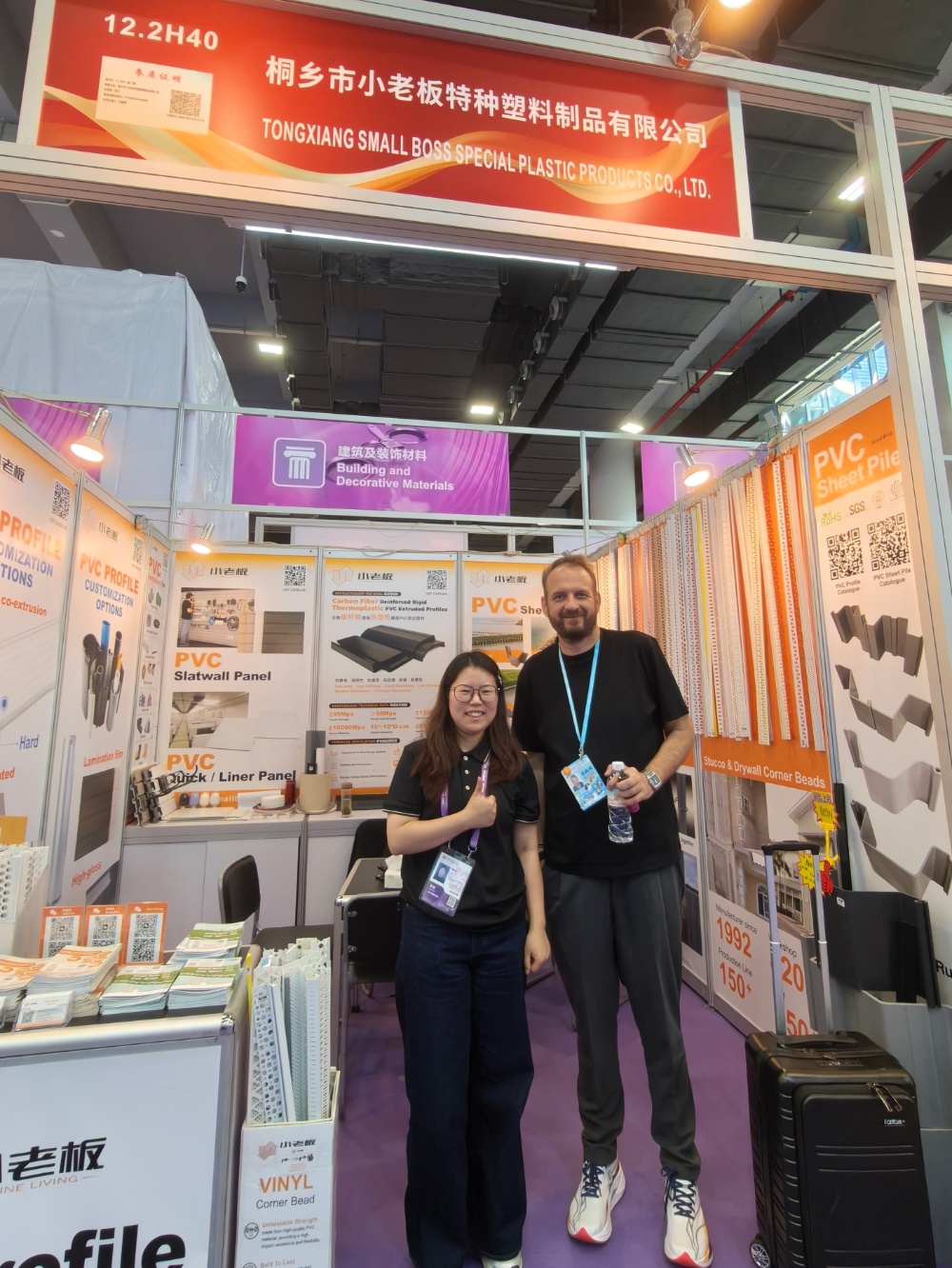
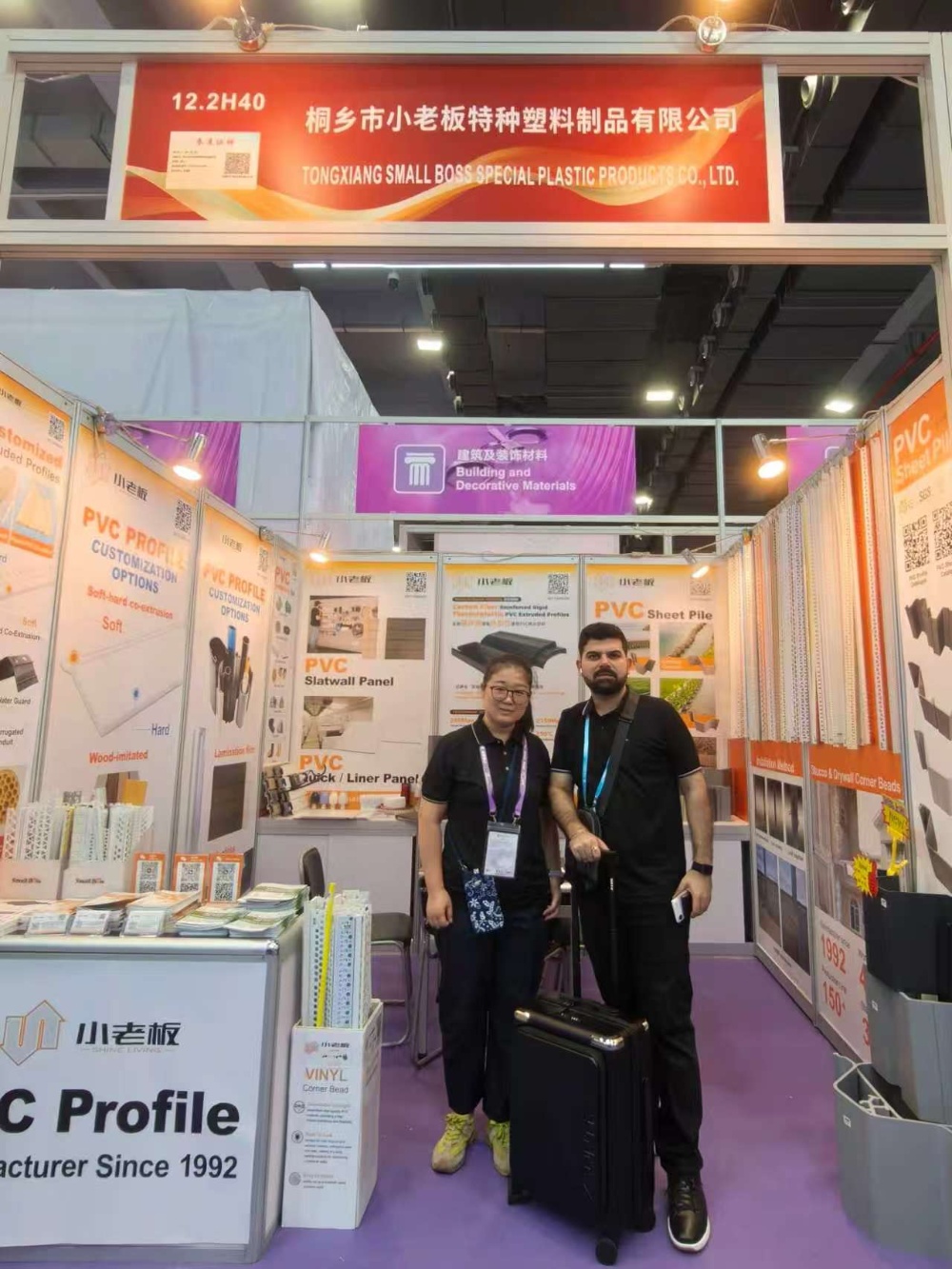
Phase 2 of the 140th Canton Fair closed on 27 October. At booth 12.2H40, Tongxiang Small Boss Special Plastic Products Co., Ltd. brought three of its four product lines — PVC sheet pile, customized extruded profiles and PVC compound — and showed for the first time a carbon-fibre blended reinforced PVC sheet pile: carbon fibre compounded into the PVC matrix, no glass fibre, no surface woven layer, aimed at deeper water, taller walls and tidal or highly corrosive conditions. Small Boss is also a core drafting member of T/CSPSTC 180—2025, the application standard for plastic sheet piles, and sizes systems by wall height, embedment depth and soil conditions.
01 The question on the booth changed
Phase 2 ran from 23 to 27 October in Guangzhou. Together with Phase 1 (15—19 October), Small Boss exhibited across both the “Advanced Manufacturing” and “Quality Home Life” sections of this edition.
Three of the four lines the company runs were on this stand: PVC sheet pile, customized extruded profiles and PVC compound. The fourth — water treatment equipment built around MBBR media — comes off the same plant and the same engineering team.
According to figures published by the Canton Fair, Phase 2 covered 515,000 m? with roughly 25,000 booths and about 11,000 exhibiting exporters; green products accounted for 26.9% of exhibits. Around 340,000 overseas buyers attended the 140th session overall. Three words came up in almost every conversation: green, low-carbon, high-performance.
For the people standing on the booth, the more telling change was in the questions. In Phase 1, buyers of PVC compound rarely asked “what is the price per tonne” any more — they asked for the formulation, the test reports and long-term supply stability. Phase 2 moved to building materials, and the questions became “how many years will this last in the tidal zone”, “what is the embedment depth”, “is there a standard we can write into the contract”.
Buyers are now costing the whole lifecycle. For a material supplier that is good news — whoever can explain what the formulation is worth has earned the right to talk about price.
02 What the launch actually changes
A carbon-fibre blended reinforced PVC sheet pile is a structural sheet pile produced by compounding carbon fibre directly into the PVC matrix and extruding it; the fibre is distributed through the material rather than applied to the surface, it contains no glass fibre, and it carries no woven fibre layer on the face.
Against the more common surface-composite approach, three differences matter.
First, the reinforcement sits in the material, not on it. A surface layer handles abrasion and appearance, but once it is damaged the reinforcement it provides is compromised. Compounding distributes carbon fibre through the whole section, so the load path does not depend on the face staying intact.
Second, zero glass fibre. No glass fibre means no glass-fibre dust to manage — an environmental and export-compliance issue in the EU and in other markets that regulate it.
Third, the operating envelope moves outward. The lightweight, corrosion-resistant, fast-to-install character of a PVC sheet pile is retained, while the range extends toward deeper water, taller walls, tidal zones and aggressive media.
This is not a sudden pivot. The same carbon-fibre compounding route has already run in volume on Small Boss rigid PVC extrusion profiles: measured flexural strength ≥158 MPa, flexural modulus ≥10,200 MPa, heat deflection temperature ≥100 °C, glass-fibre content zero, density around 1.39 g/cm? (data in the related reading below). The profile line proves that carbon fibre can be dispersed into PVC and extruded continuously; the sheet pile has to prove the material can carry structural duty. The first is measured. The second is being confirmed case by case against project conditions.
The boundary, stated plainly: a sheet pile is a structural element. Its performance is tied to wall height, embedment depth, soil, water level and load combination, and no single parameter table covers every case. Any specific figure should be confirmed against the project specification, the sample and the test report; this article does not replace project design. Published figures for the existing PVC sheet pile series are compressive strength up to 80 MPa and a 50-year design life. Figures for the new grade are confirmed per project.
03 Steel, concrete or PVC sheet pile? How to choose
The four routes are not substitutes for one another; each maps to a different set of ground conditions and cost structure. The table below compares them qualitatively on the dimensions buyers weigh most often.
| Dimension | Hot-rolled steel sheet pile | Concrete sheet pile | Standard PVC sheet pile | Carbon-fibre blended PVC sheet pile |
|---|---|---|---|---|
| Corrosion | Needs coating; continuous upkeep in tidal and salt-spray zones | Resistant, but affected by freeze-thaw and chlorides | Resists acids, alkalis and salts; no coating required | Same resistance with higher section stiffness |
| Weight and installation | Heavy; needs large lifting equipment | Heaviest; curing period required | Light; small plant or manual handling | Light; same installation method as standard PVC |
| Glass fibre | None | Depends on mix design | Usually none | None |
| Maintenance | High; periodic recoating | Low, but repair is difficult | Low | Low |
| Typical use | Deep water, high loads, temporary cofferdams | Permanent retaining walls | Small rivers, bank protection, cofferdams, seepage cut-off | Deeper water, taller walls, tidal zones, aggressive media |
| Design flexibility | Fixed sections | Cast in situ | Section options | Both formulation and section tunable to the site |
The table is a qualitative comparison of material routes. Selection for a project follows the design documents and T/CSPSTC 180—2025. On mobile, swipe the table sideways.
In one line: deep water and high loads point to steel; permanent walls point to concrete; small rivers and eco bank protection point to standard PVC; tidal zones, aggressive media and low-maintenance requirements point to the carbon-fibre grade.
04 Customized extruded profiles: six steps from drawing to production
The other half of the booth was customized extruded profiles: corner beads, seal strips, garage wall panels, and industrial profiles tooled to customer drawings.
The question buyers ask most is not “what is the price per metre” but “can you make this drawing, and how fast can I see a sample”. The process runs in six steps:
1. Formulation the compound is set against the service environment
2. Section design and structural simulation load behaviour checked before tooling is cut
3. Tooling and sampling in-house moulds and extrusion lines
4. Test reports performance data for the actual batch
5. MOQ and scheduling calculated on tooling and run length
6. Export and logistics packing and documents per destination
Small Boss brings more than 30 years of PVC profile production, with moulds and extrusion lines in-house. Section design can be handled by the engineering team; the customer supplies the service conditions and the interface requirements.
This is also why quotations vary so much. For one and the same section drawing, price is driven by seven conditions — profile weight per metre, compound system, colour, tooling cost, tolerance class, order quantity, packing and freight — and a change to the formulation, the mould structure or the tolerance band triggers a re-quote.
THE OTHER TWO LINES
PVC compound is where all four lines begin: transparent and opaque, soft and rigid systems plus CPVC, compounded in-house before anything is extruded.
Water treatment equipment built around MBBR media — municipal, rural and aquaculture wastewater — is supplied with aeration and interception systems from the same works.
05 Why the standard number belongs in the contract
Plastic sheet piling went without a unified standard for a long time, so the “applicable standard” field in a purchase contract was often left blank — and disputes surfaced at acceptance. T/CSPSTC 180—2025, Technical specification for the application of plastic sheet piles, is administered by the China Association for the Promotion of Science and Technology in Industry, co-proposed by Hohai University and Tongxiang Small Boss Special Plastic Products Co., Ltd., and drafted by 19 organisations including the China Institute of Water Resources and Hydropower Research, Nanjing Hydraulic Research Institute, Changjiang River Scientific Research Institute, China South-to-North Water Diversion Group, Minmetals Salt Lake and Sinopec Shanghai Engineering. Small Boss is the only manufacturing company among the drafters.
THE THREE NUMBERS A BUYER SHOULD ASK FOR
Standard number · Density grade · Section width × wall thickness
Put all three on the quotation and suppliers become genuinely comparable.
06 Frequently asked questions
Q: How does it differ from a standard PVC sheet pile?
The difference is in how the reinforcement is delivered. A standard PVC sheet pile gains its stiffness mainly from the section geometry. The carbon-fibre variant compounds fibre into the PVC matrix, lifting strength and rigidity at material level, which is what opens up deeper water and taller walls. How much it gains depends on the section and the site, and is confirmed by test report.
Q: Does it contain glass fibre? Is there an EU compliance issue?
No glass fibre, and no woven fibre layer on the surface. Avoiding glass-fibre dust is one of the design intents. Final compliance is still determined by the product test report and the regulations of the destination market.
Q: How deep can it be driven, and how high can the wall go?
It depends on wall height, embedment depth, soil, water level and load combination — there is no single number. Send the site parameters and the engineering team will propose a section and a pile layout following the selection logic of T/CSPSTC 180—2025, for the project designer to confirm.
Q: How do we verify the performance data?
Three routes: ask for the test report for the specific batch; ask for samples and commission third-party retesting; write the standard number and the acceptance clauses into the contract. Small Boss runs a dual-material testing laboratory, issues test reports and supports third-party testing on request.
Q: What about MOQ and lead time?
Standard sections can be quoted quickly. A custom section needs tooling, so MOQ depends on the mould, the section complexity and the order quantity; scheduling is confirmed once the section and the site conditions are fixed.
Q: We did not make the show — how do we get samples and a proposal?
Send the application, the section drawing or the site conditions — wall height, embedment depth, soil, exposure medium. Sales and technical line: +86 158 6836 5820 (tel & WhatsApp).
07 Before the next show, get the documents aligned
The show is over; the material work is not. From a pellet of compound, to a length of profile, to a finished wall, Small Boss keeps doing the same job: matching formulation and process to real site conditions.
For PVC sheet pile selection, customized extruded profiles, PVC compound samples or MBBR media, contact us directly.
TONGXIANG SMALL BOSS SPECIAL PLASTIC PRODUCTS CO., LTD.
Sheet pile selection · Customized extruded profiles · Compound sampling · MBBR media supply
Sales & technical: +86 158 6836 5820 · Tel & WhatsApp
No. 431 Tongsheng Road, Wutong Subdistrict, Tongxiang, Zhejiang, China · smallboss.com/en
ABOUT SMALL BOSS
Tongxiang Small Boss Special Plastic Products Co., Ltd. was founded in 1992 in Tongxiang, Zhejiang Province. It is a National High-Tech Enterprise and a specialised “Little Giant” enterprise, operates a provincial technical institute and a dual-material testing laboratory, and is certified to ISO 9001, ISO 14001 and ISO 45001. For more than 30 years the company has worked in PVC compound, MBBR media, PVC sheet pile and customized extruded profiles, with formulation, structural simulation, mould making, extrusion and final inspection all in-house, and exports to more than 100 countries.
RELATED READING
? Who says PVC is not strong? Carbon-fibre reinforced rigid PVC profile tested above 158 MPa
? PVC sheet pile manufacturer in China: Small Boss
Source: Canton Fair official site; National Group Standard Information Platform (searchable for T/CSPSTC 180—2025). This article is a trade-show review and product communication. It does not constitute a project design, performance, compliance or delivery commitment. Specific performance, suitability, samples and commercial terms are subject to the technical requirements and project documents confirmed by both parties.